SRIS实验室

智能系统研究

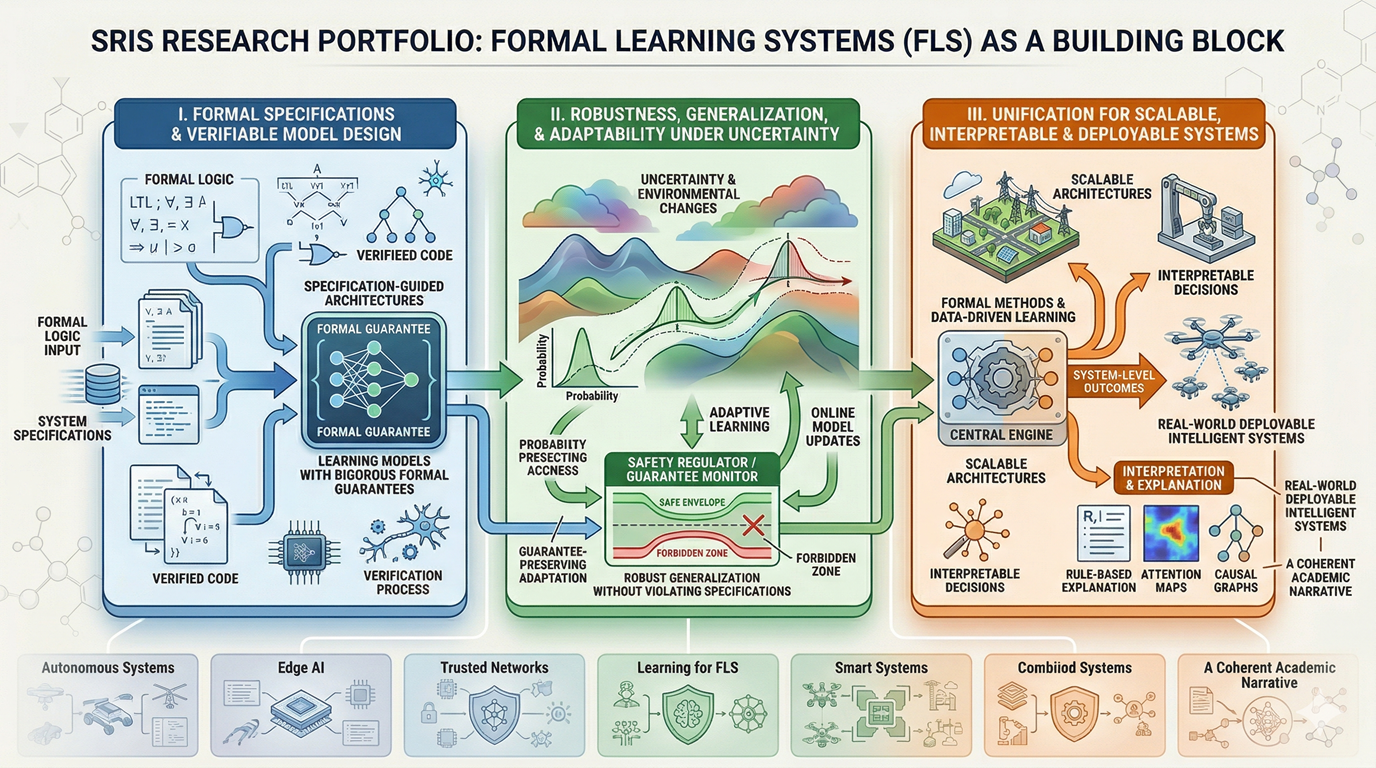
围绕可解释制造智能、安全自主与因果逻辑预测的研究方向,被组织为统一而现代的学术展示结构。

制造智能Safe AutonomyPHM形式化方法
SRIS实验室SCUT · GZIC
智能、可靠、可解释系统
Directions

三大综合研究计划

Neuro‑Symbolic Foundation Models

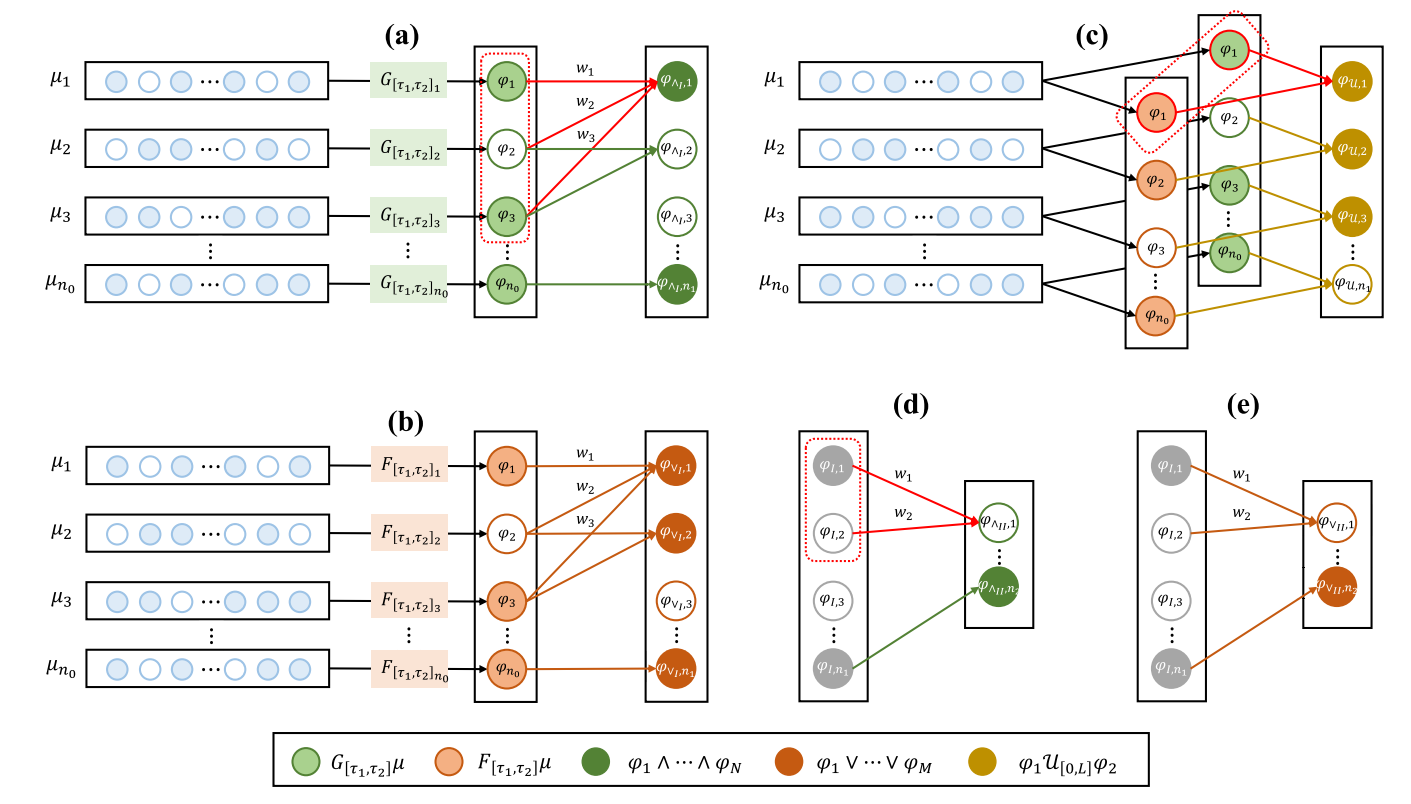
面向工业多模态预训练,结合STL正则目标与因果先验,生成可机检依据与面向控制器的输出。

STL驱动的安全自主

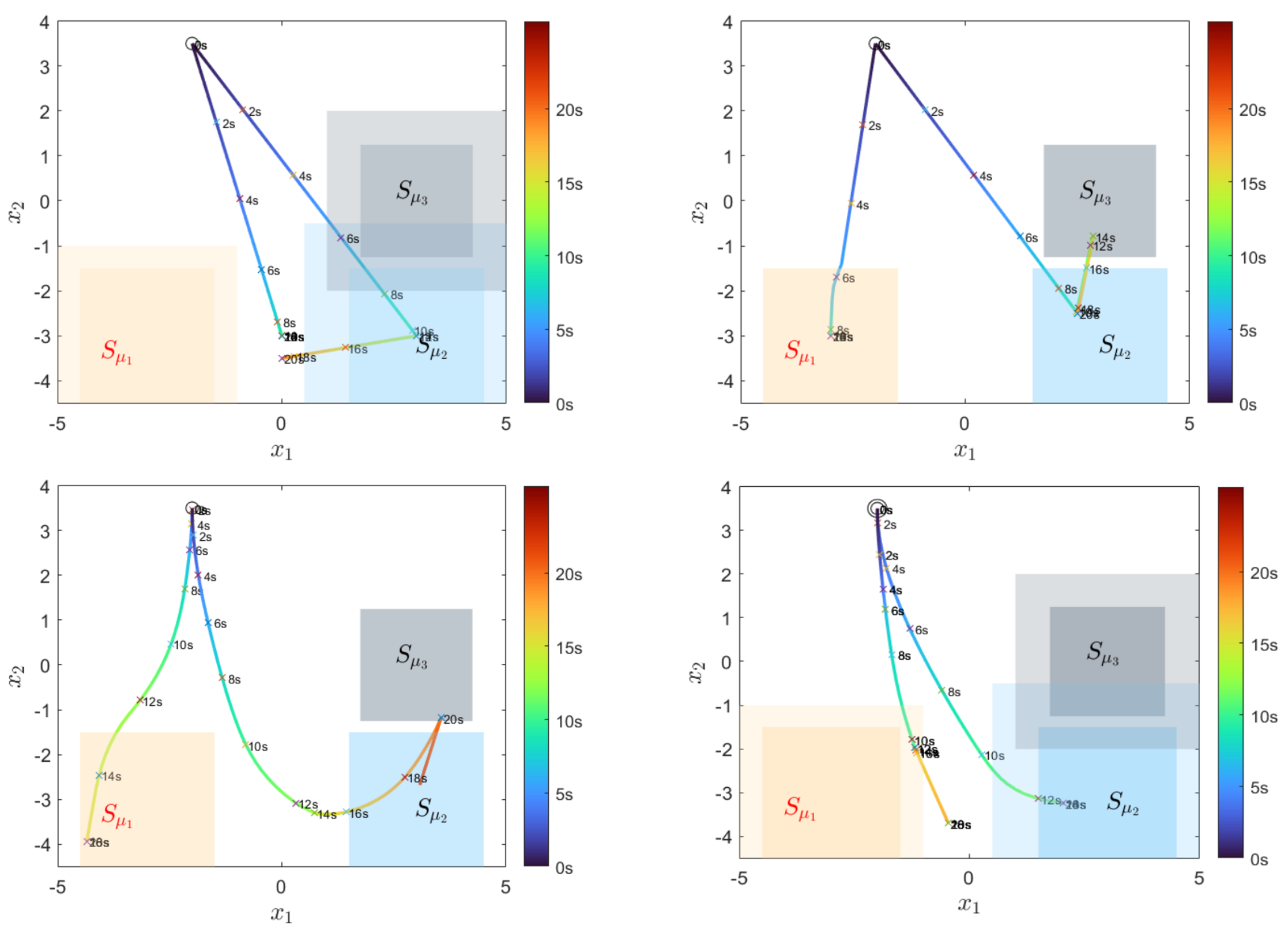
在时序逻辑契约下综合规划与控制器。参考调节器保证安全,残差强化学习在已验证管道内优化性能。

因果逻辑PHM

融合物理引导特征、因果图与STL抽象,重构传播链并为群体系统推荐成本感知干预。

Capabilities

Integrated module hub

Control and temporal logic research illustration
ExplainabilityCausalityCertification
Control and temporal logic research illustration
Barrier FunctionsReference GovernorsClosed-Loop Guarantees
Control and temporal logic research illustration
Time-FrequencyNonstationary SignalsFeature Robustness
Control and temporal logic research illustration
Long HorizonOnline ProcessingPattern Discovery
Control and temporal logic research illustration
OptimizationResource CoordinationHuman-in-the-Loop
Control and temporal logic research illustration
Neuro-SymbolicVerifiabilityPhysics Priors
深入解读

详细研究说明

01
研究详情

1. Industrial Neuro‑Symbolic Foundation Models for Trustworthy Manufacturing AI

简介
We build the next generation of manufacturing AI by unifying data‑driven learning with logic, physics, and causality. By embedding Signal Temporal Logic (STL) constraints and causal structure into the representation space, our models produce machine‑checkable rationales and calibrated uncertainty, enabling cross‑factory transfer and controller‑aware recommendations.
核心思路(理论导向)
Pretrain on multimodal industrial data (time series, events, logs) with STL‑regularized objectives , causal priors from knowledge graphs, and physics‑consistent invariants . Dual formulations turn logic satisfaction into differentiable losses; distilled symbolic rules align human audit with closed‑loop control.
关键任务
Cross‑site adaptation via knowledge‑based federated learning and domain‑invariant causal anchors. Rule distillation from embeddings to minimal STL clauses with margin guarantees. Controller‑aware heads that output safe set‑points and alarms aligned with contracts. Uncertainty quantification (e.g., conformal prediction) tied to logic satisfaction margins.
试点场景与指标
Flexible job‑shops Robotic assembly Rotating machinery Rationale fidelity Zero/low‑shot transfer Causal precision/recall National fit: 工业软件自主可控 / 新质生产力。
02
研究详情

2. STL‑Driven Safe Autonomy for Dual‑Arm & Mobile Manipulation

简介
We engineer robot autonomy that is safe by construction and fast by design. Safety is specified up‑front as temporal logic contracts and embedded throughout planning, learning, and control. The result is dual‑arm and mobile manipulation that adapts to changing workcells while certifying task timing, force limits, and human–robot interaction rules.
核心思路(理论导向)
A hierarchical stack where high‑level plans and low‑level controllers are synthesized and trained under STL specifications. Reference governors project actions onto contract‑satisfying manifolds; residual RL optimizes performance inside verified tubes. Runtime monitors provide certificate‑based intervention and graceful recovery.
关键任务
Contract mining from expert procedures; automatic refinement to STL/contract forms. Certifiable motion primitives with compositional proofs of safety and timing. Vision–force multimodal policies trained with curriculum schedules respecting contracts. Online contract monitoring with recovery policies and formal violation explanations.
试点场景与指标
Force‑controlled assembly AGV–arm handoff Rapid changeover STL satisfaction Verified accuracy Near‑miss reduction National fit: 先进制造装备与智能机器人。
03
研究详情

3. Causal‑Logic PHM for Critical Equipment Ecosystems

简介
We move beyond alarms to actionable causality in Prognostics & Health Management. By coupling physics‑guided signal processing with causal graphs and temporal logic abstraction, we reconstruct fault propagation chains across components, systems, and fleets—turning heterogeneous data into interventions that save uptime, energy, and cost.
核心思路(理论导向)
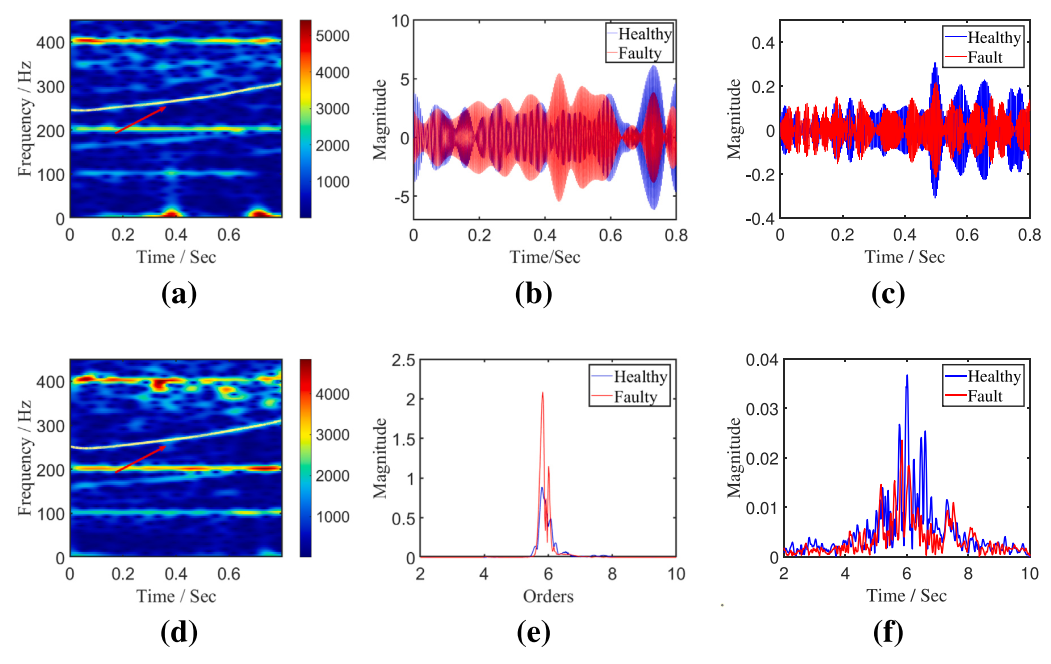
Fuse order/transfer‑path–aware features with causal discovery and do‑calculus–informed reasoning, then elevate events to STL templates that encode mechanism‑consistent signatures. Perform inference on a multi‑layer PHM knowledge graph to generate interventions (derating, maintenance windows) with transparent justifications.
关键任务
Unified ontology linking events → mechanisms → actions across fleets and vendors. Robust feature extraction under variable regimes; virtual decoupling of mixed excitations. Domain generalization with causal invariants for cross‑asset transfer. Fleet‑level decision support: counterfactual simulation and cost‑aware maintenance policies with logic guarantees.
试点场景与指标
Wind & gas turbines Rail traction CNC & spindles Lead time↑ Forced outage↓ RUL precision↑ National fit: 能源安全 / 交通强国 / 高端装备可靠性工程。
支撑项目

已资助项目

2026.01–2028.12
外骨骼具身智能关键技术与应用
广东省重点领域研发项目子课题
2026.01–2028.12
基于时序逻辑的协作机器人可解释"监控"一体化方法研究
广东省自然科学基金面上项目
2024.01–2026.12
基于时序逻辑的风电齿轮箱故障演化机理可解释定量表征方法研究
国家自然科学基金青年项目
2022.10–2025.09
海上风电机组传动链可解释故障诊断形式化定义、验证与推理
广东省自然科学基金面上项目
2023.01–2025.12
制造大数据驱动的智能装备可解释故障诊断与形式化验证
广东省自然科学基金面上项目
2023.01–2025.12
基于迁移学习的产线可解释故障诊断
广东省自然科学基金面上项目
2022.01–2024.12
基于MEC的边缘控制与实时仿真基础理论与方法研究
国家重点研发计划课题